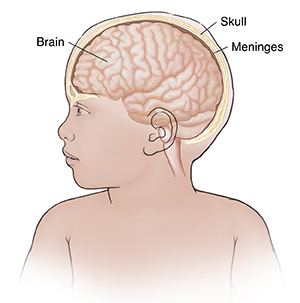
Encephalocele is a rare birth defect. It means that part of a baby’s skull doesn’t form all the way, leaving a hole. Through this hole, a sac, often covered in skin, sticks out. The sac may be filled with parts of the brain or the meninges. The meninges is the membrane that surrounds the brain. The sac may also have cerebrospinal fluid (CSF) in it. This fluid flows between the brain and the spinal cord. It protects the brain. It also carries nutrients to the brain and takes waste out of it.
An encephalocele may form anywhere along the center of the head, from the bridge of the nose to the back of the skull. The most common spot for one to form is at the base of the skull. This condition can occur by itself. Or it may be found with other neurological problems, like Meckel syndrome or Chiari type III malformation.
How to say it
ehn-SEHF-ah-loh-SEEL
What causes encephalocele?
Doctors aren’t sure why encephaloceles form. It's likely due to a mix of genetic and environmental factors. The condition can run in families. It may be caused by certain infections in a mother during pregnancy. In some cases, it may be caused by a tumor or trauma to the skull.
Symptoms of encephalocele
Doctors may find an encephalocele at birth. Or it may be spotted before birth with an imaging test called an ultrasound. The condition can cause symptoms such as:
-
No strength in the arms and the legs (paralysis).
-
A very small head.
-
Lack of muscle coordination.
-
Developmental delay.
-
Trouble seeing.
-
Delayed growth.
-
Seizures.
Your child’s symptoms may vary. They often depend on the size and location of the sac, as well as the type of material in it. Symptoms tend to be worse if the sac contains vital parts of the brain.
Treatment for encephalocele
Your child will need surgery. It's the only treatment for this condition. During surgery, a doctor uses special tools to put the contents of the sac back into the skull, if possible. The doctor then closes the hole in the skull.
Surgery may be done shortly after birth or several months to years later. It depends on your child’s condition. In some cases, your child may need more than one surgery. Plastic surgery may be advised if your child has skin or face deformities.
Possible complications of encephalocele
Your child may problems from an encephalocele. Problems include:
-
A buildup of CSF in the brain.
-
Leaking of CSF.
-
Delays in development and growth.
-
Problems with intellect.
-
An infection in the brain or spinal cord.
When to call the doctor
Contact your child’s doctor right away if your child has:
-
A fever of 100.4°F (38°C) or higher, or as directed by the doctor.
-
Symptoms that don’t get better or that get worse.
-
New symptoms.
Online Medical Reviewer: Esther Adler
Online Medical Reviewer: Lalitha Kadali
Online Medical Reviewer: Raymond Kent Turley BSN MSN RN
Date Last Reviewed: 05/01/2025
© 2000-2026 The StayWell Company, LLC. All rights reserved. This information is not intended as a substitute for professional medical care. Always follow your healthcare professional's instructions.