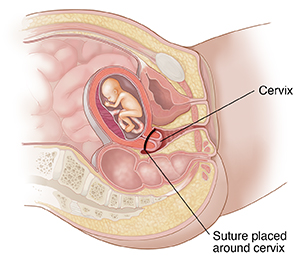
Cerclage is surgery to close the cervix. The cervix is the narrowest part of the uterus. It links the uterus to the vagina. The surgery stops the cervix from widening (dilating) too early during pregnancy.
How to say it
ser-KLAHZH
Why cerclage is done
Cerclage is done to prevent the loss or early birth of a child. It’s done if you are pregnant and have a weak or short cervix. You otherwise may not be able to carry a baby to full term.
Your cervix may be weak because of an injury, such as from a past procedure like dilation. Or you may have been born with a weak cervix. If you've lost a pregnancy or given birth early in the past, you're more likely to need a cerclage.
How cerclage is done
This procedure is often done on an outpatient basis. That means you can go home afterward. During the procedure:
-
You are given medicine so you don’t feel pain. You may be awake or asleep.
-
The surgeon puts a speculum into your vagina. It helps the surgeon see the cervix better.
-
Your bladder is emptied.
-
Forceps are used to hold the cervix in place.
-
The surgeon closes the cervix with stitches (sutures).
Risks of cerclage
These include:
-
Bleeding.
-
Infection.
-
Injury to the cervix.
-
Rupture of the bag of water (amniotic sac).
Author: Semko, Laura
Online Medical Reviewer: Daphne Pierce-Smith RN MSN
Online Medical Reviewer: Tennille Dozier RN BSN RDMS
Online Medical Reviewer: Vinita Wadhawan Researcher
Date Last Reviewed: 06/01/2025
© 2000-2026 The StayWell Company, LLC. All rights reserved. This information is not intended as a substitute for professional medical care. Always follow your healthcare professional's instructions.