Recovery

After Hip Replacement: Sitting Safely

Choose a preferred language


Learn the safe way to sit to protect your new hip. Follow the instructions below.


Sitting higher

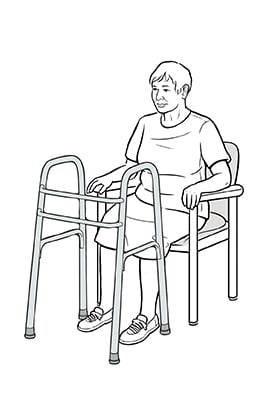
To protect your new hip, you must sit with your knees lower than or level with your hips. To do this, sit in chairs with high seats. Or you can place a firm pillow on the seat of a chair to help raise your hips.
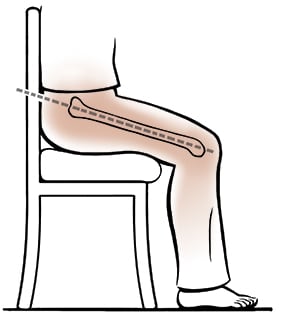
Side view of person seated in higher chair,  showing knee lower than hip.


To sit down

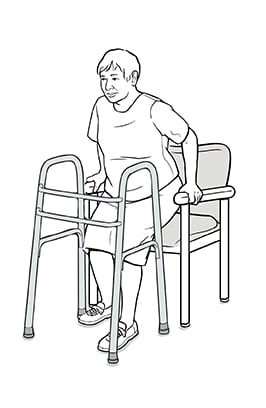
To sit down, back up until the edge of the chair touches your leg. Then, using the armrests to support your weight, lower yourself into the seat. Always keep out in front the leg that was operated on.
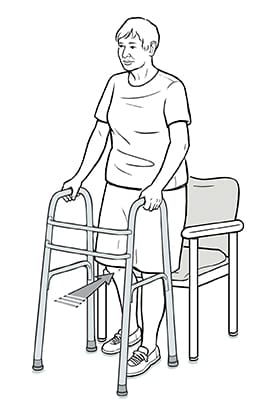
Person using walker backing up into chair so that chair touches back of legs.

Person with hands on arms of chair and lowering self into chair, keeping operated leg slightly out in front.

Person seated in chair with hips higher than knees.

Online Medical Reviewer: Rahul Banerjee MD

Online Medical Reviewer: Raymond Turley Jr PA-C

Online Medical Reviewer: Stacey Wojcik MBA BSN RN

Date Last Reviewed: 07/01/2023

© 2000-2026 The StayWell Company, LLC. All rights reserved. This information is not intended as a substitute for professional medical care. Always follow your healthcare professional's instructions.


FPC Locations

FPC Locations

Find a Provider

Find a Provider

Our Services

Our Services

Patient Portal

Patient Portal
Related Articles
Read article
Orthopedics
After Total Hip Replacement: Recovering at Home

A total hip replacement is major surgery and the recovery can be long. Learn more about how you can protect your new hip and have a good recovery after you leave the hospital.

Read article
Orthopedics
Transfers After Leg Amputation

After your amputation, you will need to learn how to transfer safely.

Read article
Orthopedics
Headache After Spinal Tap (No Patch)

If there is a loss of too much spinal fluid from a leak at the puncture site after a spinal tap, the spinal fluid pressure goes down and a headache occurs. This headache may be mild or severe. There may also be dizziness, nausea and blurred vision. Here's what you need to know.

Read article
Orthopedics
Activity and ACL Rehabilitation

Once you are ready for it, your healthcare provider will help you ease back into your active life. You can do certain exercises to help you build up your agility. Agility is ease and quickness of movement.