Torticollis happens when muscles on one side of the neck contract (tighten). This causes the neck to twist or tilt to the side. The muscles may also be quite sore. It affects mainly children and young adults, often appearing overnight. It can also affect infants who develop or are born with tight neck muscles on one side.
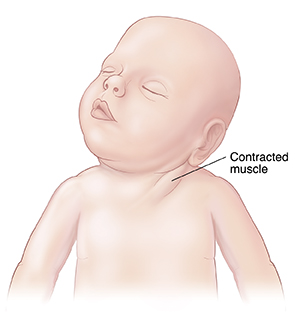
What causes torticollis?
Causes of torticollis include:
-
Congenital (present at birth). Injury to the neck muscles from an accident or other injury, or even just sleeping in an unusual position
-
Side effect of certain medicines or drugs
-
Problems with the bones of the neck (which can happen after an infection or injury)
-
Spasm of the muscles due to an infection, such as an abscess in the neck
When to go to the emergency room (ER)
All neck problems should be checked by a healthcare provider within 24 hours. Get emergency care if you can't reach your healthcare provider or if you have these symptoms:
-
Trouble breathing or swallowing or in smaller children, continuous drooling
-
Numbness or weakness in the arms and legs
-
Trouble walking or speaking
-
Fever or chills
What to expect in the ER
The neck will be examined, and questions about any current or former health problems will be asked. Neck X-rays may be taken to check for broken bones.
Treatment
The goal in treating torticollis is to relax the neck muscles. The best method will depend on the cause of the problem. In most cases, one or more of these may be given:
-
Medicines. These help relax the muscles and reduce swelling.
-
Hot and cold compresses. These help ease muscle tightness.
-
Botulinum toxin injections. These are done to prevent further muscle spasms.
-
Physical therapy. This helps stretch and relax the muscles.
-
Surgery. If nonsurgical treatment has not been successful, then surgery may be recommended to lengthen the muscle.
After the ER: When to get medical advice
Depending on the cause, torticollis often goes away on its own. Follow the instructions from the ER and follow up with your healthcare provider as instructed. Call your provider right away or return to the ER if any of these occur:
-
More neck pain
-
No relief with the medicines prescribed
-
Symptoms get worse
Call 911
Call 911 if any of these occur:
-
Trouble swallowing or breathing
-
Skin or lips that look blue or gray
-
Increasing pain or severe pain that doesn't go away
-
Sudden weakness, numbness, or tingling in the arms or legs
-
Loss of control of bladder or bowels
Online Medical Reviewer: Raymond Turley Jr PA-C
Online Medical Reviewer: Rita Sather RN
Online Medical Reviewer: Thomas N Joseph MD
Date Last Reviewed: 10/01/2024
© 2000-2026 The StayWell Company, LLC. All rights reserved. This information is not intended as a substitute for professional medical care. Always follow your healthcare professional's instructions.